Within the high-stakes realm of contemporary professional drifting, podium finishes is far more than exclusively a result of raw engine power or driver bravado. Rather, it has evolved into a multifaceted science which necessitates a painstaking marriage of choosing a inherently capable chassis, arming it with the highest-quality drift-spec hardware, and, most importantly, grasping its dynamic characteristics on the circuit through advanced drift telemetry software. This definitive guide functions as your blueprint from the initial concept of a drift build right through to the final engineering-refined tweaks that turn a capable machine into a repeatable winner. We will examine in detail the precise engineering of car suspension tuning, illustrating how a advanced vehicle dynamics tool like GripDial eliminates guesswork and provides exceptional clarity into your car's actual behavior.
The bedrock of any successful competitive sliding vehicle is, without question, the chassis itself. Several cars have attained iconic status within the international oversteer scene due to their built-in balance, durable build quality, and the vast availability of performance components available. Selecting the optimal starting point is the primary and most important choice a enthusiast will make. As an example, the the E36 generation BMW is widely regarded as among the finest balanced drift cars of all time. Its almost ideal evenly distributed mass, coupled with a RWD setup and robust inline-six engines, creates a chassis that is both easy to handle for newcomers and incredibly capable in the control of a pro competitor. The evolution of this philosophy, the E46 model BMW, builds upon these attributes with a increasingly developed structure, broader stance for greater stability, and even more steering angle straight from the factory. Another formidable option in the pro arena is the C6 generation Corvette.
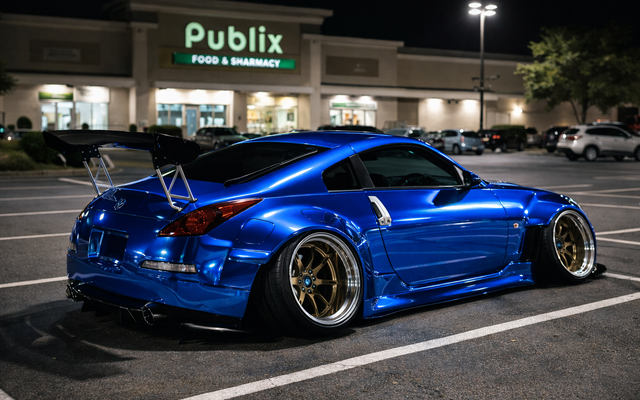
This American track weapon introduces a particular combination of advantages to the sliding discipline, including a low-mass alloy chassis, a transaxle-style drivetrain component that contributes to an excellent balance, and the colossal torque of a large-displacement LS-series V8 engine. This blend transforms it into an complete weapon on track, capable of entering and maintaining extended angles with apparently easy deployment of throttle. For drivers looking for remarkable value, the 350Z model Nissan stands out as a top-tier candidate. It arrives from the manufacturer with a rigid chassis, a effective OEM LSD, and the free-revving VQ series engine that provides ample horsepower and torque for mastering and progressing in the sport. Its successor, the 370Z model, presents additional refinements in chassis stiffness, suspension design, and overall motor power, cementing its place as a favorite selection among serious pilots. Additional historic cars that deserve consideration include the nimble rotary-powered Mazda FC, the ubiquitous Nissan S13, the V8-powered Ford SN95, the electronic-equipped BMW E90, and the small yet surprisingly fun and forgiving Mazda Miata. All of these chassis provides a unique set of attributes, complexities, and possibilities, but they all possess the basic components essential to become a competitive drift machine.
However, choosing the correct car is only the first step. To access the true performance of every of these machines, significant modifications to the steering and damping and springing systems are completely mandatory. This is where the domain of precision aftermarket hardware comes into sharp focus. The one most impactful upgrade for a dedicated drift car is the integration of a drift-spec angle modification kit. These advanced systems, like those engineered by industry leaders like SLR Speed, are designed to radically enhance the car's maximum lock-to-lock rotation. A factory road car is severely restricted in how far its front wheels can rotate, a engineering limitation for daily driving. In drifting, however, extreme opposite lock is continuously required to control and maintain a angle. An steering kit replaces the OEM steering knuckles, rod ends, and often control arms with components that permit the front tires to reach angles over 70 or even 80 degs, versus a typical OEM limit of around 40 to 50 degs.
This tremendously expanded lock offers the operator with dramatically greater control during a angle, making it considerably more straightforward to start a drift, sustain it through a sweeping turn, and transition fluidly from one angle to the other. The difference in handling is absolutely revolutionary. Paired with a appropriately selected steering kit is the just as essential upgrade to the chassis's damping system. Off-the-shelf or including high-end road coilovers are just not intended for the unique and harsh demands of sliding. A drift-spec pair of adjustable dampers is crucial. These engineered dampers feature specific damping rates and spring rates that are optimized for the rapid mass transition that is typical of drifting. When a pilot starts a slide, the car's mass is shifted violently to the outside of the bend. Proper performance dampers handle this shift in a consistent way, permitting the car to find its balance quickly and providing the operator accurate feedback through the wheel and driver's seat. They furthermore provide precise adjustment of ground clearance, shock absorber rate, and corner weighting, which are all key elements of dialing in the vehicle's handling to a given circuit or competition approach. Together, a precision-engineered angle modification system and a expertly specified pair of performance adjustable dampers constitute the undeniable physical cornerstone upon which all future refinement is constructed.
Once the essential hardware is fitted, the subsequent essential step in the development is the detailed setting of the vehicle's suspension geometry. This is the domain of vehicle alignment optimization, a methodology that can seem intimidating to the newcomer but is, in fact, the key to transforming a set of capable components into a unified and consistent whole. The most critical element of suspension geometry for drifting is certainly camber angle. Camber angle is the tilt of the rim relative to the upright line when looked at from the front of the car. When the top edge of the tire is leaning towards the car, this is called negative camber. In sliding, an inward tilt on the front axle wheels is universally employed and is seen as necessary. The reason is fundamentally linked to tire contact.
When a car is cornering at extreme sideways angles, the frame leans to the external of the turn. This body roll forces the outer steering tire to lose its optimal contact patch with the asphalt. By adding negative camber, the tire is pre-leaned to compensate for this lean. As the chassis tilts into the turn, the tire becomes more upright on the asphalt, increasing its traction at the precise moment when it is needed most for directional command. Commonly, front axle angles for a dedicated sliding vehicle fall between approximately -3 degrees to as much as -5 degrees or even beyond, based on the specifics of the vehicle geometry, rubber choice, and operator preference. The back wheels also utilize inward lean, but the settings are usually less and subtler than the front axle. Overly aggressive camber at the rear can make the car extremely prone to oversteer and difficult to control on throttle input, as it diminishes the available grip area of the powered tires during linear throttle application. Therefore, rear angles are commonly in the range of -1 degree to -3 degrees, finding a precise balance between offering adequate cornering grip to aid in initiating and maintaining the angle while still maintaining effective traction for exiting the corner. camber angle is merely one element of the broader alignment equation, which furthermore involves toe setting, self-centering steering, and steer correction modification.
Toe is the orientation of the wheels when looked at from above. Positive toe means the leading edges of the tires are closer together than the trailing edges, while negative toe means the converse. For drifting, a modest amount of front negative toe is frequently run to sharpen the initial steering response, making the vehicle feel more nimble and ready to begin a slide. Rear axle toe angle is generally set to neutral or a incredibly minute amount of toe-in to promote predictability under power. caster angle is the frontwards or aft inclination of the steering axis when viewed from the side-on of the car. More positive caster improves self-centering and stability solidity, and it also boosts camber gain during cornering, which is very useful. Adjusting these parameters is a detailed interplay where a adjustment to one setting can and often will influence the remaining parameters. The old-school method for tuning a car's suspension geometry for drifting has historically been a time-consuming endeavor of guesswork and adjustment. A tuner or crew would make a modification based on experience, test the car on track, use the operator's personal feel and feedback, and then apply an additional tweak. This loop would repeat over and over until the chassis felt "right" or the allotted track period was exhausted. This methodology is not just incredibly wasteful in terms of hours and resources, but it is furthermore inherently inaccurate.
Driver perception is a famously subjective data source, influenced by countless elements such as tiredness, varying track conditions, temperature, and merely the focus of the operator on that given day. What feels "tail-happy" on one lap might feel "tight" on the subsequent pass, causing conflicting feedback and counterproductive changes. This age-old limitation in vehicle dynamics optimization is specifically where modern telemetry systems has intervened to revolutionize the landscape.
The development and adoption of advanced suspension tuning applications has brought about a new era for engineering and perfecting high-performance sliding vehicles. These platforms, exemplified by groundbreaking products like modern telemetry hardware, function by physically recording the real-time mechanical performance of the vehicle as it is operated on the track. In contrast to using subjective impression, these tools acquire objective metrics on essential factors such as damper compression and extension, corner drift suspension tuning guide velocities, G-force loading, steering angle, and throttle and brake input. This acquired telemetry is then interpreted by powerful applications that can plot and decode the information in a actionable manner. For the very first time, drivers and builders can see exactly what the vehicle is exhibiting at every moment of a lap. This ability transforms the complete alignment optimization procedure. Consider the specific challenge of optimizing the front camber for a particular car. Instead of applying a change from -3 degrees to -3.5 degrees and then running multiple runs to try and "perceive" a improvement, a suspension tuning tool can deliver immediate and irrefutable information. The software can indicate in a chart how the wheel's grip is behaving during the key moments of a slide: the initial flick, holding the angle, and switch. It can demonstrate if the present camber setting is allowing the outside front tire to maintain optimal loading or if the compound is working inefficiently on its external shoulder.
The tool can subsequently make data-driven advice for modification. Perhaps the data reveals that the outside front tire is still overloading its outer shoulder at -3.5 degrees of negative camber, indicating that an increase to negative camber, say -4 degrees, might be beneficial. Alternatively, the information might show that the tread is failing to reaching temperature or that the inside edge is wearing unevenly, which could indicate that there is excessive negative camber and a modest decrease back to -3.2 degrees would be more efficient. This degree of precision and practical intelligence was simply impossible in the days of pure mechanical adjustment.
The impact of employing a advanced suspension tuning tool extends well beyond merely dialing in camber angles. It functions as an priceless suspension tuning guide that is customized to your particular vehicle. When fine-tuning the rebound and compression clickers on your coilovers, instead of relying on imprecise advice or mimicking another car's setup, you can employ the telemetry to analyze how the chassis is performing coilover setup tips in reaction to your changes. The application can show the wheel movement trace over a section of track, revealing if the coilovers are controlling the body movement effectively or if they are permitting the vehicle to bounce uncontrollably after a transition. It can assist in pinpointing problems like bottoming out or losing droop, permitting you to make educated adjustments to spring preload, rebound/compression values, or ride height. This methodology extends equally to the intricate art of car alignment tuning. Beyond camber angle, the software can provide data into how adjustments to toe settings and caster are affecting the car's handling during different maneuvers of a slide. For instance, it can allow you to determine the optimal amount of front axle negative toe for your specific steering configuration and competition approach by measuring the speed of initial reaction and the predictability of the vehicle at full steering angle. This turns the tool an extremely useful vehicle dynamics manual that is actively informed by the live dynamics of your specific chassis on the track. It moves the entire project from a dark art into a repeatable optimization process.
Moreover, the value of a tool like data acquisition is in no way confined to professional engineers with extensive funding. For the club-level competitor, it functions as an powerful educational tool. It in essence provides the tuner with the analysis of a expert race engineer without the associated overhead. It drastically shortens the development time by delivering definitive solutions to challenges that would traditionally take years of trial and error to answer. A builder can understand how their particular chassis reacts to various adjustments, developing a more profound comprehension of car control in the process. It furthermore opens up advanced chassis dynamics concepts, allowing all drivers with the desire to refine their machine to accomplish it in a systematic and effective fashion. This is especially important in a sport like oversteer competition, where tuning knowledge has in the past been a highly secretive asset among top crews. Today, that knowledge can be in the toolkit of any motivated driver.
In summary, the process to engineering and tuning the ideal championship-contending drift car is a comprehensive endeavor that smoothly blends proven hardware principles with revolutionary digital suspension engineering tools. It begins with the informed selection of a legendary platform, then built upon the integration of critical competition components like drift-spec steering angle kits and expertly specified performance coilovers. The build then advances into the intricate realm of chassis dynamics adjustment, where parameters like camber angle, toe setting, and caster are carefully adjusted to complement the car's new capabilities and the pilot's specific style. The final step, and what really distinguishes the modern process from the past, is the adoption of a sophisticated suspension tuning application. This system eradicates the guesswork and waste of only subjective setup by delivering quantifiable, actual data on how the car is truly performing. It functions as an indispensable engineering partner, a actionable drift suspension tuning guide, and a comprehensive chassis development system. Together, this holistic philosophy ensures that each and every component of the drift car—from the selection of the chassis to the last tweak on the suspension—is perfected for maximum performance on the competition venue. It represents the full maturation of the discipline of drifting, merging mechanical pilot talent with precise suspension engineering to create the most competitive vehicles possible.